


Gatekept
Mathematics
The algebra, trigonometry and geometry books the best sixth formers once worked through, before maths education was rewritten: secondary school became free for everyone, far more students took maths, and the subject itself was being modernised. Wider, but with less depth.
The books
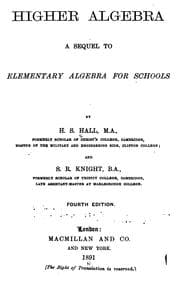
Higher Algebra
H. S. Hall, S. R. Knight · 1887
The sixth-form algebra book for half a century: inequalities, series, combinatorics and probability, with long problem sets drawn from examination papers.
Plane Trigonometry, Part I
S. L. Loney · 1893
School trigonometry done thoroughly, with hundreds of graded problems, many as hard as olympiad questions.
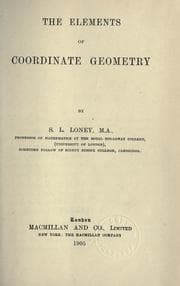
The Elements of Coordinate Geometry
S. L. Loney · 1895
Lines, circles and conics by coordinates: the companion to his trigonometry, and just as rich in problems.
Algebra: An Elementary Text-Book, Part I
George Chrystal · 1886
Algebra for the strongest pupils and first-year undergraduates: deeper and more rigorous than Hall & Knight.
The Thirteen Books of Euclid's Elements, Volume 1 (Books I–II)
Euclid, Thomas L. Heath · 300 BC
Euclid was the backbone of school geometry until the early twentieth century; Heath’s edition is the one to read now.
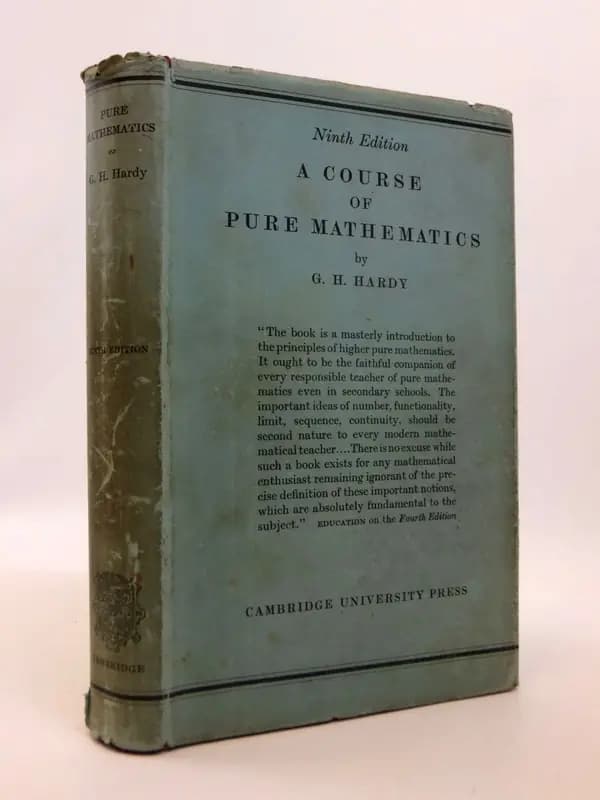
A Course of Pure Mathematics
G. H. Hardy · 1908
Written for the best scholarship candidates and first-year undergraduates: where these books lead.
Why they stopped being taught
Who these books were for
Until the 1950s only a small share of pupils studied mathematics beyond sixteen, mostly at grammar and public schools, preparing for the Higher School Certificate or for university scholarship examinations. Books like Hall & Knight’s Higher Algebra (1887) and Loney’s Plane Trigonometry (1893) were written for them: chapters of technique, then hundreds of problems, many taken from examination papers.
What changed
After the war, maths education changed in two ways at once: it opened up to far more students, and it was modernised. From the 1960s the “modern mathematics” movement, led in Britain by the School Mathematics Project (founded 1961), brought in sets, matrices, transformations, vectors and statistics, and moved time away from long algebraic and trigonometric manipulation and Euclidean geometry.
At the same time, far more pupils were taking mathematics. The 1944 Education Act had made secondary school free for every child; comprehensive schools spread after 1965, the school leaving age rose to sixteen in 1972, and GCSE and the National Curriculum followed in 1988. Textbooks were rewritten for a much wider range of students, with shorter exercises and more worked examples, and calculators, common in classrooms from the 1970s, made some of the old technique seem unnecessary.
Wider, but less deep
The curriculum grew wider: statistics, mechanics and later decision mathematics, more applications, and more choice of modules. What thinned out was depth in the core: fluent algebra, inequalities, series, trigonometric identities, proof, and above all long problems that take an hour rather than five minutes.
Universities noticed. In 1995 the report Measuring the Mathematics Problem described new undergraduates as less fluent in technique, less able to tackle problems needing more than one step, and less used to precision and proof. In 2004 the Smith inquiry, Making Mathematics Count, looked again at A level after the Curriculum 2000 changes. Since then, Further Mathematics, olympiads and STEP have been where the strongest students meet problems of the old kind.
Why read them now
They are cheap second-hand, and Hall & Knight and Loney are still reprinted in India, where they remain standard preparation for the JEE. Their problem sets are among the best practice there is for olympiads, STEP and the first year of a maths degree. And because few students use them now, working through one gives you something of your own to talk about.
Sources
Measuring the Mathematics Problem: London Mathematical Society, Institute of Mathematics and its Applications and Royal Statistical Society, 1995.
Making Mathematics Count: the report of Professor Adrian Smith’s Inquiry into Post-14 Mathematics Education, 2004.